
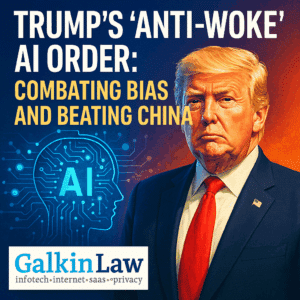
The Trump administration is reportedly preparing an executive order that would introduce new compliance obligations for federal contractors deploying artificial intelligence (AI) tools. The order, as described in recent news reports would require federal contractors to affirmatively certify that their AI systems are politically neutral.
Though the public discourse has framed this proposal as targeting “woke AI,” the legal implications for contractors – particularly those operating in defense, compliance, analytics, and automation – are more nuanced and merit careful analysis.
The Executive Order: A Policy Shift with Legal Reach
The proposed order is expected to:
- Mandate that AI systems used in federal contracts not exhibit or reinforce political bias;
- Establish certification requirements attesting to the ideological neutrality of AI systems;
- Expand AI deployment in federal operations, including tax enforcement and military applications;
- Reinforce AI-related procurement controls, potentially linking funding or eligibility to content moderation and training dataset provenance.
Implications for AI Governance and Risk Allocation
If implemented, this executive order would mark a significant extension of AI governance requirements within federal procurement. Notably, it would expand existing ethical AI frameworks (which traditionally focus on privacy, discrimination, and transparency) to include ideological neutrality – a concept not yet well-defined in law or practice.
1. Political Neutrality as a Procurement Condition
Contractors may be expected to:
- Vet their training data and outputs for indications of political bias;
- Adjust generative or decision-support tools to eliminate ideological leanings;
- Certify AI systems as “neutral” under standards yet to be articulated.
These obligations raise critical questions:
- What constitutes “political bias” in AI?
- Who defines neutrality, and under what rubric?
- How will enforcement be carried out, and what liabilities will attach?
2. Increased Documentation and Audit Exposure
Legal departments may need to prepare for:
- Expanded documentation duties concerning training data sources, fine-tuning parameters, and output filtering;
- Pre-award or post-award reviews focused on content neutrality;
- Potential suspension or termination clauses for violations or misrepresentations.
3. Contractual Flow-Downs and Risk Mitigation
Primes will need to pass through neutrality obligations to subcontractors, especially those supplying foundational models, middleware, or user-facing interfaces. Lawyers will need to assess:
- Indemnity structures;
- Representations and warranties on content generation;
- Termination rights tied to political output controversies.
Broader Strategic Context
This order is not isolated – it fits within a broader federal strategy to reassert U.S. leadership in AI development and deployment. Accompanying measures include:
- Lifting export restrictions on Nvidia’s H20 chips;
- Fast-tracking infrastructure for AI data centers;
- Expanding partnerships with leading U.S. AI firms (e.g., OpenAI, Anthropic, Google, xAI) for defense and public sector innovation.
Together, these developments suggest that AI alignment – technological and ideological – will become a central axis of federal acquisition strategy.
Considerations for Legal Counsel
Legal teams supporting federal contractors should proactively:
- Review AI product architecture and training sources for potential exposure to political bias claims;
- Update internal AI governance policies to include neutrality standards, content filtering protocols, and escalation mechanisms;
- Revisit contract templates to address evolving procurement requirements, including preemptive certifications and compliance assurance;
- Engage cross-functional risk teams to align legal, technical, and operational perspectives on neutrality and transparency.
Conclusion
The Trump administration’s proposed executive order marks an inflection point in the federal government’s approach to AI procurement. While the rhetoric may focus on “woke AI,” the legal reality for contractors is more complex: a potential obligation to affirm and prove ideological neutrality in machine-generated content.
For legal counsel, this presents a new frontier in AI compliance – one where traditional doctrines of fairness and transparency must now accommodate political viewpoint neutrality as a regulatory expectation.
GalkinLaw advises technology providers on AI governance, compliance, and emerging regulatory trends. For guidance on navigating these evolving standards, feel free to reach out.